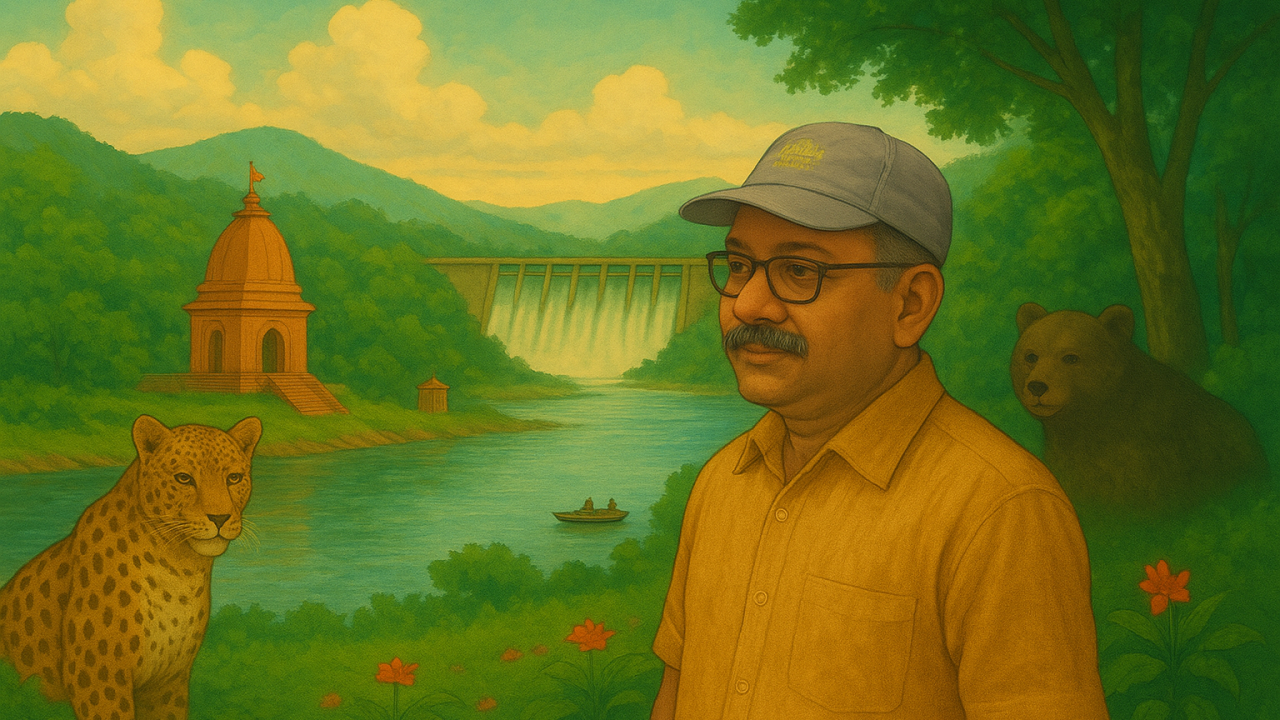
Sambalpur has always had a special place in my heart. My recent visit, as part of the Rangabati Festival immersion tour, was not merely a journey to a city; it was a homecoming, a rekindling of memories, and a rediscovery of beauty that is both timeless and soul-stirring.
The visit began on a sacred note, when we had an evening Darshan of Maa Samaleswari followed by the light & sound show. What happened then was very humbling; the evening Aarati, which is normally not open to general public. It was courtesy dear Sanjeev Nayak, that I had this spectacle of nearly 45 minutes.

Maa Samaleswari


With the Rangabati Team!!
From there, our journey took us to the Pataneswari Temple, another cultural and spiritual landmark. The aura of the temple, steeped in centuries of devotion, spoke volumes about Sambalpur’s enduring faith and resilience. Standing in its courtyard, I felt the continuity of time – of generations before us who had sought blessings there, and of generations yet to come who will keep this legacy alive.

Pataneswari Temple
The next morning started with a nostalgic trip to Hirakud Dam.
No visit to Sambalpur is complete without experiencing the Hirakud Dam. Standing before one of the longest earthen dams in the world is always awe-inspiring, but this time it touched me differently. The vast reservoir stretched like an ocean, reflecting the sky in shimmering hues. The engineering marvel, completed in independent India’s early years, is not just about harnessing water – it is about human vision and determination.
As I gazed at the expanse, the waves lapping against the shores seemed to sing songs of aspiration. The reservoir’s tranquil beauty, framed by hills and greenery, was ethereal. It reminded me that Sambalpur is as much about natural grace as it is about human ingenuity.

Hirakud Dam
If being in Sambalpur on a Nuakhai Day was not adequate, the Nuakhai lunch at Maa Samaleswari Temple, the presiding deity of Sambalpur and the spiritual heartbeat of the region, was truly elecrtifying. Sitting within the temple premises, partaking in the traditional feast, and experiencing the warmth of the community was far more than a ritual meal. It was a communion with tradition, a reminder of how food, faith, and festivity seamlessly bind people together in Sambalpur. It was a great opportunity to listen to the Original Singer of Rangabati song Padmashri Jitendra Harpal Jee,

Nuakhai Byanjan
Play Video
Rangabati by Padmashree Jitendra Harpal
One of the most personally gratifying occasions was the opportunity to present my book Plain Speak Management – Insights from Life’s Lessons to the Hon’ble Minister of Education Shri Dharmendra Pradhan Jee. His interaction thereafter with the Rangabati Festivals’ delegates was a sheer pleasure, where he spoke eruditely about the rich history of Sambalpur with stories of Surendra Sai, Kodapalli and many others. It was something to carry home and ponder about.

This immersion was particularly moving for me because Sambalpur is not just a city I admire; it is a city I once called home. As a child, I spent three formative years in Kamali Bazar, and the streets still carry the fragrance of my boyhood days. Passing by, I could almost hear the echoes of laughter, play, and innocence that shaped my early life.
Equally nostalgic was reminiscing about my daily trips to Zilla School. The discipline of the school, the bonds with classmates, and the foundation it laid for my later years all came rushing back in a flood of memories. To revisit these places after so many years was like opening a time capsule, each sight and sound weaving together the boy I once was with the man I am today.
The last chapter of this immersive journey was set in the Debrigarh Sanctuary, a gem tucked away by the Hirakud reservoir. Our night stay there was one of the most memorable parts of the visit.
As dusk fell, we embarked on an evening boat journey to Bat Island. The ride itself was magical; the reservoir waters shimmering under fading light, the hills darkening in the horizon, and the rhythmic hum of the boat blending into nature’s evening song. At Bat Island, time seemed to stand still. Sharing laughter and stories with fellow travelers while relishing the simple joy of local fish fry, freshly prepared and bursting with flavor, was a moment of togetherness that will remain etched in memory.

Mahanadi after Twilight
The next morning brought us closer to the wild. We set out on a trek through the lush green sanctuary. Although we didn’t spot many animals, the forest offered something deeper – the scent of wet earth, the rustling of leaves, the songs of unseen birds, and the cool breeze brushing against the skin. It was less about sight and more about feeling – being embraced by the jungle’s quiet power.

Sunrise

Sunrise

Morning Trek

Morning Trek Group
The safari ride further deepened that experience. Moving through the dense woods, with the canopy above filtering morning sunlight, I realized that nature’s grandeur is not always in what we see, but in what we sense. The lush greenery, the play of light and shadow, and the sheer vitality of the forest floor were humbling. I left Debrigarh floored, not by exotic animal sightings, but by the realization of how deeply restorative nature can be when you simply pause and let it speak.

Sambar
As this immersion drew to a close, I carried back with me not just sights and sounds, but also emotions. Sambalpur is not just a city – it is a confluence of history, spirituality, art, nature, and above all, people. From Maa Samaleswari’s blessings to the legacy of Veer Surendra Sai, from the threads of Sambalpuri handloom to the serenity of Hirakud and Debrigarh, this journey stitched together the many identities that make Sambalpur extraordinary.
For me, it was also a deeply personal reconnection – to my childhood in Kamali Bazar, to the boy who walked to Zilla School every day, to the emotions that only a place called “home” can evoke after years away.
A special word of gratitude to the Organisers of the Rangabati Festival; Shri Mohit Gupta and Shri Prakash Sahu. It was through their thoughtful invitation and meticulous planning that we could experience Sambalpur in such an immersive way. Their efforts went far beyond logistics; it was about curating memories, shaping connections, and offering us the opportunity to live Sambalpur rather than just visit it. I must thank the other members namely Shri Ajay Kaul, Shri Arjun Bajpayee, Smt Bijoy Laxmi & Ms Reila Hota, and Gita Mathur for their contribution in terms of creative ideas so as to take Sambalpur to the “Manas” of people every where!! As we go from here to different cities and finally for a show in Delhi, I am sure Sambalpur will surely etch its indelible marks.
As I left, I carried Sambalpur in my heart once again – its temples, its dam, its forests, its flavors, and its people. And I know, this was not an ending, but a continuation of a bond that will always remain.
Sambalpur doesn’t just stay with you; it becomes a part of you.